Rhythmic Gymnastics Leotards: History, FIG 2025–2028 Rules, and How Much They Really Cost
A routine lasts ninety seconds. Gymnasts spend years getting ready for them.
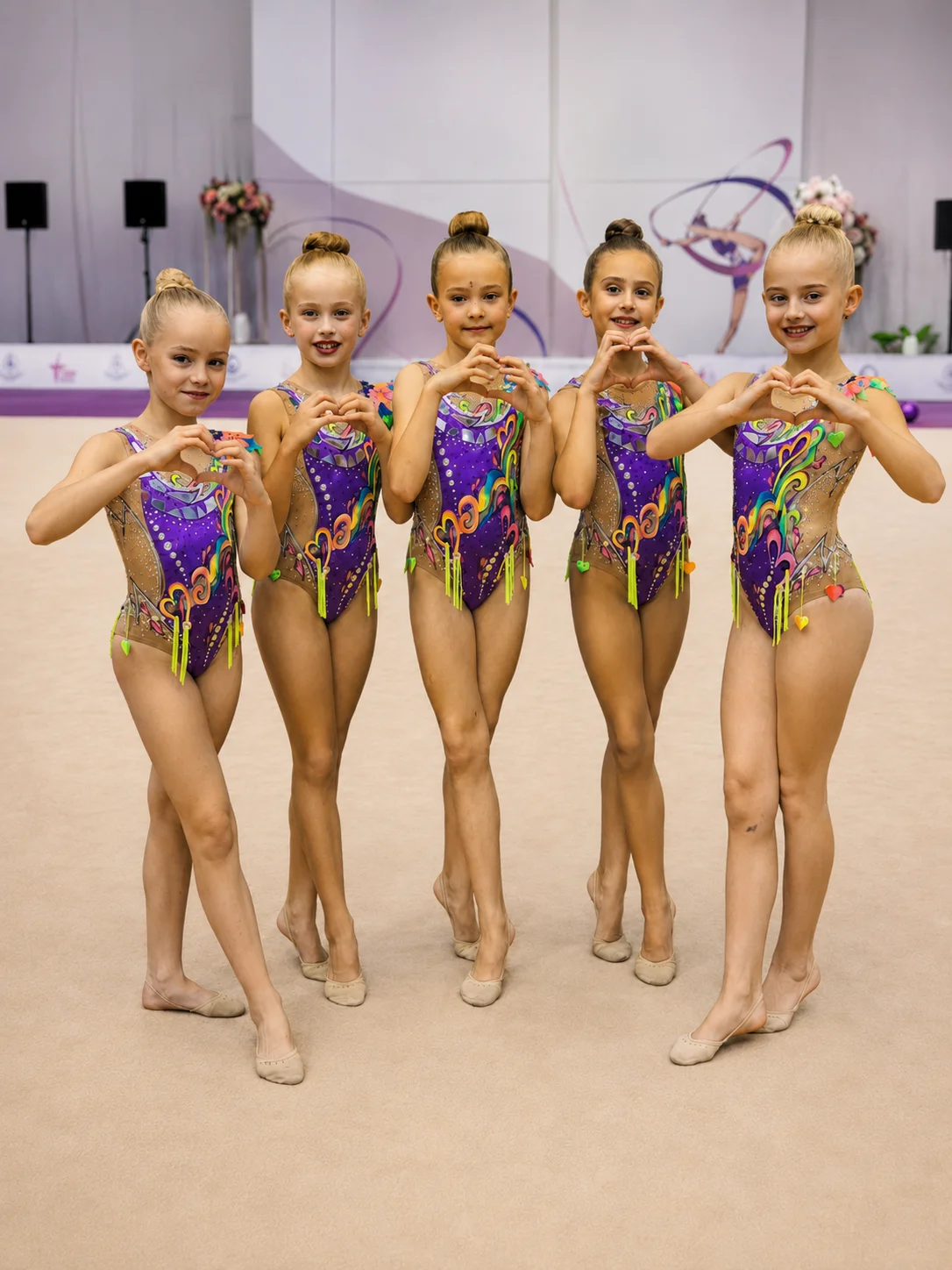
Rhythmic gymnastics is an Olympic sport where an athlete performs a routine to music while handling an apparatus. Body movement, apparatus work, musicality, expression, and technical precision all have to come together at once — which is why it looks like a stage performance but gets scored like a sport: on difficulty, artistry, and clean execution.
Three separate judging panels score every routine. The Difficulty panel (D) rates how hard the body and apparatus elements are and how many high-risk skills the gymnast packed into the routine. The Execution panel (E) tracks technical cleanliness — precision of movement, dropped apparatus, sync with the music. The Artistry panel (A) judges whether the choreography, music, and character of the piece actually hang together as one coherent performance. The leotard technically falls under the Artistry panel's territory, but it also carries its own separate rule set with its own penalty — more on that below.
Senior individual routines use four pieces of apparatus: hoop, ball, clubs, and ribbon. A gymnast isn't just jumping, balancing, and spinning — she's constantly working the apparatus into the routine: throwing it, catching it, rolling it, passing it, redirecting it. That ongoing relationship between body, apparatus, and music is what makes rhythmic gymnastics its own discipline rather than dance or acrobatics with extra steps.
FIG itself describes rhythmic gymnastics as a sport built at the intersection of athletics and art — shaped by ballet and contemporary dance, but ultimately scored on risk, difficulty, and execution, not just on how good it looks. That's exactly why the leotard isn't just a pretty outfit. It has to support the story of the routine, flatter the line of the body, and still meet the competition rulebook to the letter.
Competitions run in two formats:
- Individual routines — one gymnast, one apparatus, 75–90 seconds
- Group routines — five gymnasts working as a single unit; synchronization isn't a nice-to-have, it's a requirement
How the Leotard Evolved: From Plain Wool Knits to Swarovski Couture
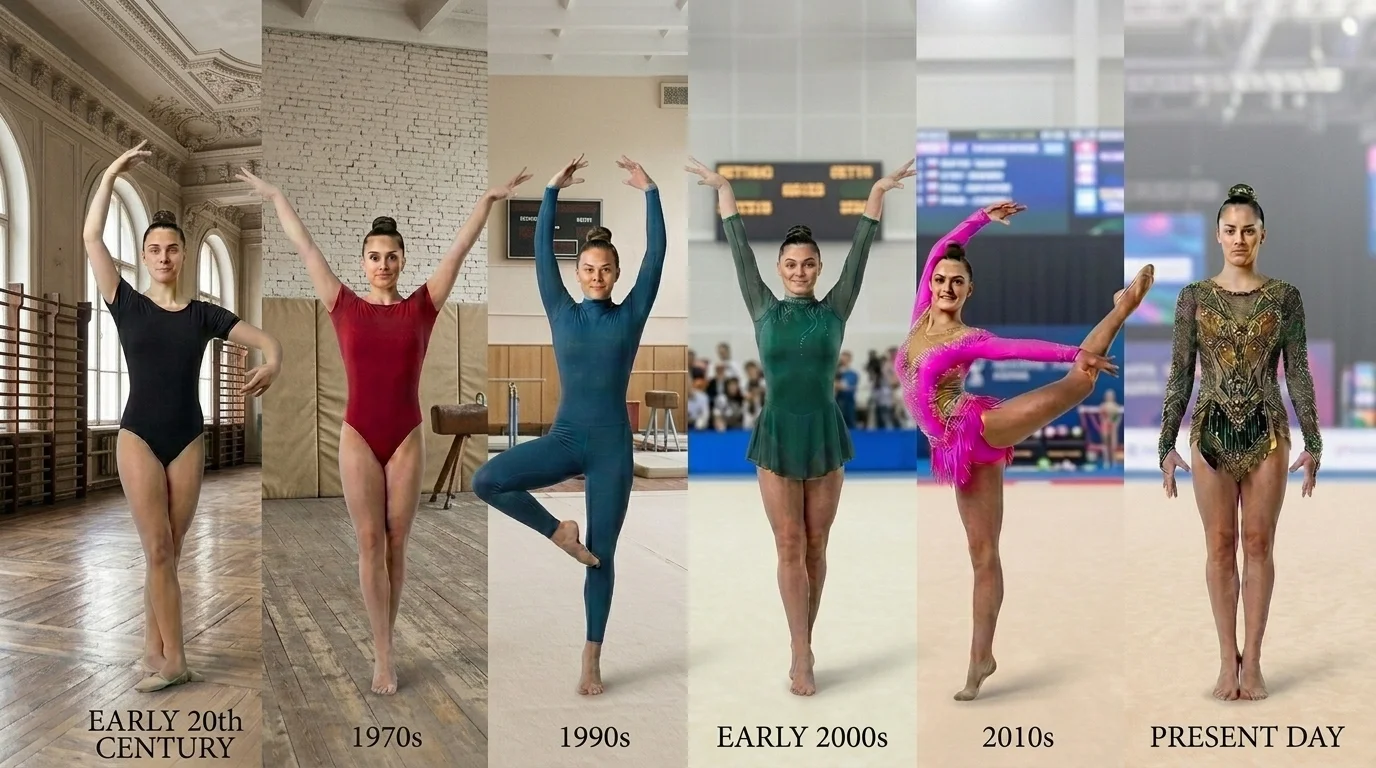
Rhythmic gymnastics started out modestly. The earliest leotards were plain, single-color, made from heavy knit — no rhinestones, no daring necklines. The point was to stay invisible and let the athletic content do the talking. The leotard itself was an afterthought.
The 1970s: the first step toward today's silhouette. Stretch fabric arrived, and the leotard finally hugged the body the way it does now. Movement read more clearly, body lines became more expressive, and it became obvious that clothing could work *with* a routine instead of just covering the athlete.
The 1990s: unitards enter the picture. Once FIG allowed Muslim athletes to compete in fully covered costumes, full-length unitards caught on fast — not just with athletes who needed them for religious reasons, but with everyone. A new silhouette opened up a whole new design language.
Sydney 2000: the skirt becomes a statement. FIG officially allowed a skirt over the leotard, and gymnasts ran with it immediately. Russian Olympic champion Alina Kabaeva was the first to compete in one, and it landed like a small revolution — suddenly the look was theatrical, memorable, almost cinematic.
The 2000s: everything that used to be banned became the norm. Fringe, asymmetry, dense rhinestone work, neon color — FIG lifted most of the old restrictions on decoration, and the leotard turned into something closer to a costume for a one-woman show.
Today: a leotard built to move with the body. A modern competition leotard is a piece of design in its own right. Appliqué placement is engineered so individual elements visually "travel" with the gymnast's motion. Lace, organza, and chiffon create a sense of weightlessness. Crystals have largely replaced sequins, and on a top-level leotard, the crystal work alone can cost more than the fabric, cutting, and sewing combined.
FIG 2025–2028 Rules: What Gets Checked Before You Step on the Carpet
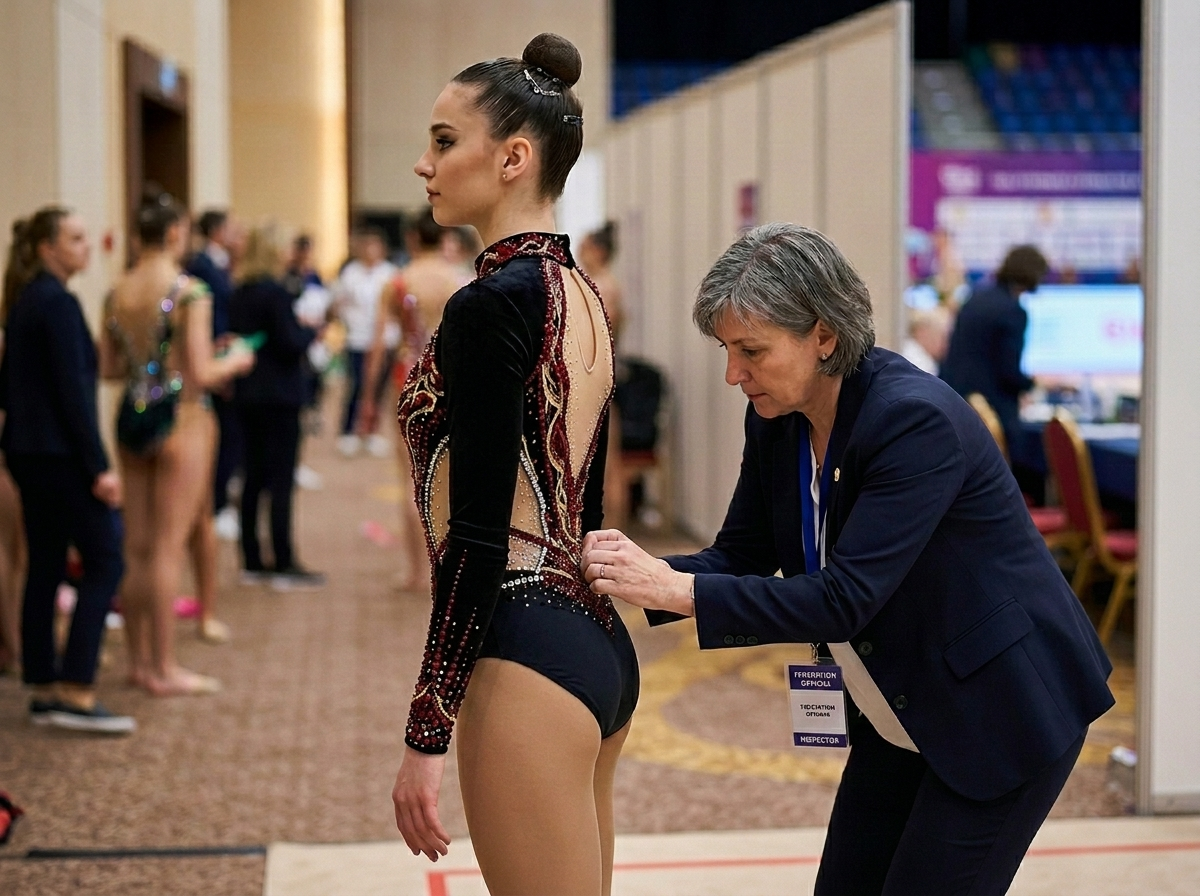
Every leotard is inspected before the gymnast even enters the competition hall. If it doesn't meet the rules, the deduction is applied immediately — before the routine has even started.
The rules currently in force were set by FIG for the 2025–2028 Olympic cycle. The official document sits on the FIG website; here's a direct link to the RG Code of Points PDF.
Quick Answer
| Element | Allowed |
|---|---|
| Thin straps | Yes |
| Tutu-style skirt | No |
| LED decoration | No |
| Small, close-fitting stud earrings | Yes |
| Colored bandages or wrap material | No |
| Separate gloves or decorative leg warmers | No |
The Leotard: Core Requirements
The leotard has to be modest and non-transparent. Any lace inserts need an opaque lining underneath, covering the torso up to the chest.
The fit has to be close. The whole point is that judges need to be able to read the position of every part of the body clearly.
Necklines, front and back, can go no lower than half the sternum in front and the bottom edge of the shoulder blades in back. On the legs, the cut has to sit exactly along the natural crease at the top of the thigh — not above it, not below it.
The hips and seat have to be covered in opaque, non-skin-tone fabric up to the top of the hip bones. A small sheer or skin-tone panel at the sides is allowed only as a decorative join, and only if there's still a continuous, opaque, colored panel connecting the front and back of the leotard.
Sleeves
One real change from the previous cycle: thin straps are now allowed. Sleeves can be any length, or none at all. Sheer fabric on the sleeves is fine, as long as it fits snugly along the entire length of the arm.
Legs
Bare legs are allowed, as are full-length tights worn over or under the leotard, or a leotard with built-in full-length leggings.
Not allowed: shorts, mid-length tights, decorative leg warmers.
If there's fabric on the legs, the color and length of the base layer have to match on both legs. Only the pattern or cut is allowed to differ.
The Skirt
A skirt is allowed, as long as it doesn't extend below the hip line. A few conditions apply:
- A tutu-style cut is not allowed
- The skirt has to be permanently attached to the waistband of the leotard — a separate skirt on an elastic band doesn't qualify
Accessories and Decoration
Another change this cycle: small, close-fitting earrings are now allowed. Previously, jewelry of any kind was banned outright.
LED decoration is banned.
Separate gloves, decorative leg warmers, and belts are banned — the leotard has to read as one continuous garment.
Appliqués and rhinestones are allowed, but they have to sit flush against the base fabric and can't create any safety risk for the gymnast.
Hair and Makeup
Hair has to be styled compactly, without bulky accessories. Any hair decoration needs to sit close to the bun and stay put — it can't slip onto the skin. Adjusting hair mid-routine is not allowed.
Makeup should be light and clean. Theatrical makeup is banned, and touching it up mid-routine is not allowed either.
Penalties
Every infraction is flagged once, by the Responsible Judge, per routine.
| Infraction | Deduction |
|---|---|
| Leotard doesn't meet the requirements | −0.30 |
| Large jewelry or piercings that create a safety risk | −0.30 |
| Hairstyle doesn't meet the requirements | −0.30 |
| Theatrical or excessive makeup | −0.30 |
| Incorrect or missing emblem/advertising | −0.30 |
| Colored bandage or wrap material | −0.30 |
Rhythmic gymnastics is ballet performed on a carpet, where every single movement has a point value attached to it.
What a Competition Leotard Actually Costs
The price range here is huge. At one end, a plain cotton training leotard costs about as much as a nice t-shirt. At the other end, a competition piece with hand-applied Swarovski crystals can run into the thousands — there's genuinely no ceiling on the high end.
Fabric. Biflex is the industry-standard fabric for competition leotards — Italian mills like Carvico are the benchmark. Good biflex holds its shape in any body position, doesn't stretch out, and doesn't wrinkle. It costs more than cotton, but it's exactly what gives a leotard the kind of fit judges are trained to look for.
Decoration. Crystals are their own line item in the budget — and on a high-end competition leotard, they routinely cost more than the cutting and sewing combined. Several Western custom-leotard studios set their free-shipping threshold at $250, which gives a rough sense of where pricing starts even before crystal work is added.
Format. A leotard from a standard product line is cheaper. A made-to-measure leotard costs more — but it's the only way to get the kind of fit where the leotard moves like a second skin instead of getting in the way.
There's one cost factor that's easy to overlook until it's too late: in the individual program, a gymnast works with four pieces of apparatus — hoop, ball, clubs, and ribbon — and it's standard practice to sew a separate leotard for each routine. That's not one costume for the season; it's four. Budget for all four from the start, not just the first one.
A Pattern Made to Your Measurements — Where the Right Fit Starts
No off-the-rack leotard fits the way one cut for a specific body does. In rhythmic gymnastics, that matters more than almost anywhere else: judges are watching the lines of the body through a split, a bridge, a leap — and a bad fit reads instantly.
With AROA, this takes a few minutes. Your measurements turn straight into a finished pattern, ready to print or take into a graphics editor to refine further.
Build your pattern in AROA and get a ready-made base to work from.
Build a pattern from your own measurements →